Table Of Content
- College claims discovery of George Washington's hair, but fears DNA testing could destroy historic find
- A Lock of George Washington's Hair Has Been Discovered Hidden in an Old Book
- Old News, Vintage News, Historical News, Retro News
- Strands of George Washington’s hair found in book
- Subscribe to History Facts
- Get the book
- Massachusetts Historical Society

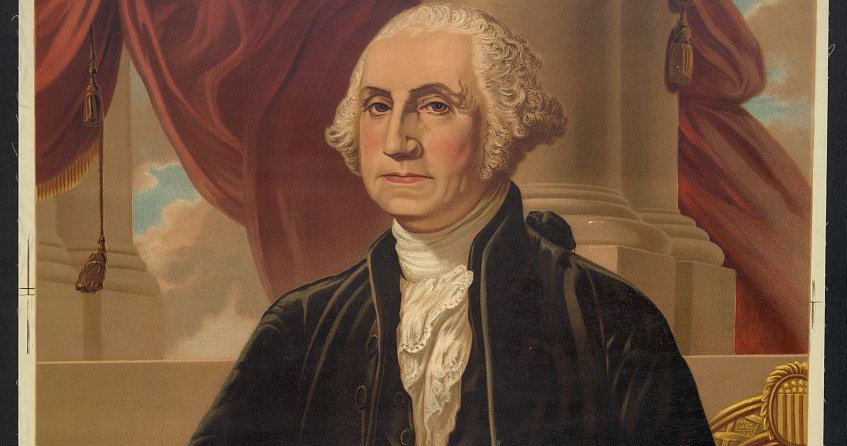
Despite all the familiar portraits depicting George Washington with white hair, America’s first President was closer to a natural redhead than many people realize. Though physical evidence is sparse, biographers have noted that the founding father boasted a reddish-brown mane. These darker locks can be seen in portraits of Washington as a young man, including paintings by artists Jean Leon Gerome Ferris and John C. McRae. There’s also a locket at Washington’s Mount Vernon estate containing a lock of reddish hair that was presented to Treasury Secretary Oliver Wolcott Jr. in 1797. While many men in America wore wigs before the Revolutionary War, this practice began to go out of style after 1776. By the time Gilbert Stuart painted this portrait in 1796, Washington’s habit of powdering his own natural hair would have fit the fashion of the day.
College claims discovery of George Washington's hair, but fears DNA testing could destroy historic find
In the twenty years since the FBI study, the techniques of mitochondrial DNA capture, sequencing, and analysis have grown increasingly sophisticated, making it possible to extract much more information from even fragmentary pieces of hair. A repetition of the 1976 and 1994 studies today would undoubtedly prove far more conclusive, but few, if any, owners are willing to allow the destruction of these objects to confirm their true origin. With or without scientific proof, ultimately, the appeal and power of relics from America’s greatest civic deity rely on their provenance, their presentation…and faith. On at least two occasions over the past forty years, modern techniques of forensic analysis have been applied to hair samples purported to have come from Washington in an effort to determine their authenticity. The first investigation, carried out by the Orentreich Foundation for the Advancement of Science in New York in 1976, used a scanning electron microscope to examine several well-provenanced examples. After several months of study, the investigators were willing to issue a cautious confirmation that the historic hair could have come from the president.21 At least they could not rule him out as the source.
A Lock of George Washington's Hair Has Been Discovered Hidden in an Old Book
Or the White House, George Washington did help build the capitol. In July 1790, Congress passed the Residence Act which called for the permanent capital of the United States to be located on the Potomac River. When President George Washington signed the bill, he took personal control over the building of what he once termed "the seat of Empire." He specified the location of the ten-mile square federal district, the President's mansion (the White House), and the Capitol. At the beginning of his presidency, George Washington and the first family resided at the Samuel Osgood house in New York City. Located uptown facing the East River, it was just a few long blocks away from the countryside.
Old News, Vintage News, Historical News, Retro News
Throughout his life, Washington employed numerous full and partial dentures that were constructed of materials including human, and probably cow and horse teeth, ivory (possibly elephant), lead-tin alloy, copper alloy (possibly brass), and silver alloy. The college doesn't anticipate DNA testing the specimen anytime soon, Spartz agreed. "[The hair] would be permanently destroyed as part of the DNA testing," said Bettinger. "To me, it makes sense at the current time [to wait to DNA test]." "The biggest problem is contamination," Dr. Blaine Bettinger, a genealogist, told ABC News. "There would be DNA results [after a test], but figuring out if the results are from the hair's DNA or if it is the DNA of someone who has handled the hair would be the difficulty."
Uncovering strands of history tied to lock of hair that may have been George Washington's - Tampa Bay Times
Uncovering strands of history tied to lock of hair that may have been George Washington's.
Posted: Mon, 19 Feb 2018 08:00:00 GMT [source]
“It’s not hugely valuable, maybe two to three thousand dollars for the strands you have, but it’s undoubtedly George Washington’s,” Reznikoff told college officials. The book was noteworthy in itself, as it belonged to Philip J. Schuyler, the son of Gen. Philip Schuyler, a wealthy New York senator who served in the Revolutionary War and was the father-in-law of Treasury Secretary Alexander Hamilton. Enter your email to receive history's most fascinating happenings in your inbox each day. Comments and respectful dialogue are encouraged, but content will be moderated. Please, no personal attacks, obscenity or profanity, selling of commercial products, or endorsements of political candidates or positions. We also cannot address individual medical concerns or provide medical advice in this forum.
National History Day in Massachusetts
Experts aren’t entirely sure, but it's likely a convoluted story, one that reads like a “who’s who” of the Revolutionary era. Schoelwer says Mount Vernon has five dozen hair samples that are reported to have come from Washington's head. Union College says the hair was found in an envelope tucked between the pages of a 1793 leather almanac. Inside the 1793 almanac, researchers found several strands of the Founding Father’s white hair, which had been held together by a delicate string. Hair was also a souvenir you might want from someone you admired, like a president.
Subscribe to History Facts
Instead, a spring would force the top of the dentures up as Washington opened his mouth. This meant that to keep his mouth closed, Washington must have been in a lot of pain gritting his teeth together. As for George Washington, the early years of his adulthood were often spent in military uniform. Once elected as the first president of the United States, Washington had to decide what the ultimate appearance of an American president would look like.
Get the book
On occasion, he—or an attendant—would bunch the slack into a black silk bag at the nape of the neck, perhaps to help protect his clothing from the powder. Then he would fluff the hair on each side of his head to make “wings” and secure the look with pomade or good old natural oils. As for keeping the powder off one’s shoulders, how Washington did that—if he did do that—nobody could tell me. Probably every powder-wearing guy in the 1760s knew the secret, but after a couple of centuries, whatever Washington did to stay spotless is lost to us. She claims that the historical evidence that was discovered in December 2017 alongside the hair is enough for the college to consider the locks of hair as the real deal. "It could just be a way to remember me, because people didn't know if they'd see each other again in those days; life was more fleeting," said India Spartz, who is the head of archives at Union College, which is about to intersect with our old hair story in a big way.
Massachusetts Historical Society
Strands from George Washington, Andrew Jackson, and Abraham Lincoln still survive around the country. Recently, another piece of Washington’s mane popped up in a 1793 almanac at a college library in Schenectady, New York. For example, following the end of his presidency and prior to his departure from Philadelphia, George and Martha Washington paid a visit to the Secretary of the Treasury, Oliver Wolcott and his wife, Elizabeth. Washington had appointed Wolcott in 1795, and the two men shared many professional and personal ties. Stuart admired the sculpture of Washington by French artist Jean-Antoine Houdon, probably because it was based on a life mask and therefore extremely accurate.
His hair would be colored white with wig powder, which could sometimes be an issue in terms of making it look like a snowy day on your shoulders or ruining a lady’s dress while you dance. To achieve the actual ‘do, Washington kept his hair long and would then pull it back into a tight braid or simply tie it at the back. This helped to showcase the forehead, which was very in vogue at the time.
Houdon used precise pupil and eye measurements to approximate the appearance of the eyes while open. Although most of us think we know what George Washington looked like (the wig, the outfit…they both live etched in our American memory), when looking at the actual features of each man, they look like brothers instead of versions of the same man. Susan Schoelwer, who is the Robert H. Smith senior curator at Mount Vernon, Washington's estate, says proving it is the real deal can be a problem. If the hair was cut, it won't contain the follicle — the part most easily tested.
How DNA can reveal the eye and hair color of the longtime dead - The Week
How DNA can reveal the eye and hair color of the longtime dead.
Posted: Thu, 08 Jan 2015 08:00:00 GMT [source]
His cherry tree myth is the most well-known and longest enduring legend about George Washington. — -- Union College has purportedly stumbled across an historic find hidden in the contents of a library book -- but the school is resisting a DNA test that could confirm the centuries-old find. With hair and book in hand, Myers had to restrain himself from literally running through the library to Spartz, the archives director. There were only a few strands, tied neatly in a loop with a piece of thread. "I'm like, I'm no expert, but that really feels like the real deal." The catalogue librarian, John Myers, unclasped the book's old cover and sat down to see what is inside it.
The first president’s Mount Vernon home and museum in Virginia also houses about four dozen samples of his hair; some of it set in jewelry, as was popular at the time. Mostly hidden from public view, scores of putative locks of George Washington’s hair are held, more than two centuries after his death, in the collections of America’s historical societies, public and academic archives, and museums. Excavating the origins of these bodily artifacts, Keith Beutler uncovers a forgotten strand of early American memory practices and emerging patriotic identity, as exemplified by the craze for collecting locks of Washington’s hair.
Left image photograph by Osama Shukir Muhammed Amin FRCP(Glasg) CC 4.0. Right Image Re-creation of George Washington from his life mask, Copyright Royalty Now Studios. We actually have surviving locks of George Washington’s hair, which interestingly have sold at auction for almost $40,000. Luckily, in 1785,when Washington was 53, French sculptor Jean-Antoine Houdon visited him at his Mount Vernon residence.


No comments:
Post a Comment